The Luminous Receiver
When an inward event becomes a signal
The screen does not reveal a thought. It reveals the agreement that made a trace worth keeping.
A Room Full of Warmth
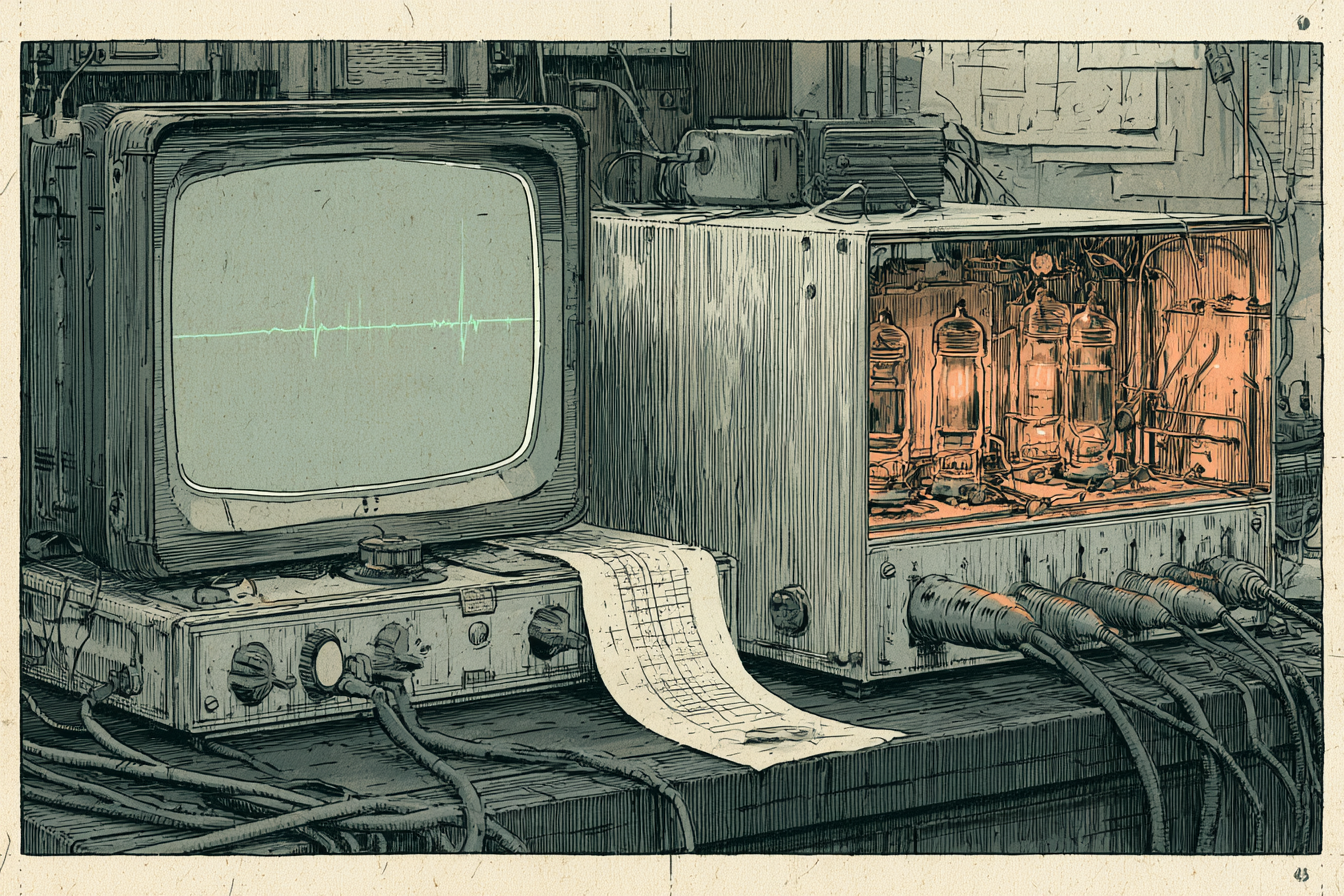
A laboratory built around vacuum tubes announces itself before it is understood. There is the hum of a transformer, the slow warming of glass, the smell of dust meeting heat, and the small domestic drama of a line that refuses to settle. Such rooms made an impression of directness. A current entered one side of an apparatus, a trace appeared on the other, and a difficult event seemed to have acquired a public face. Yet the screen's green light was never a bare fact. It was the last visible part of a chain of choices about electrodes, gain, filtering, timing, and what counted as noise.
The promise of the luminous receiver was not that it could inspect consciousness without interpretation. Its promise was humbler and more powerful: it could hold a fleeting variation still long enough for several people to discuss it. A pulse on paper could be passed across a table. A waveform could be compared with another run. An observer could ask whether a mark arrived before or after a stimulus, whether it survived repetition, and whether another instrument made the same difference visible. (Peter Galison 1997)
This altered the emotional climate of inquiry. An old notebook preserved an observation in the voice of its writer; an electronic trace seemed to stand apart from anyone's voice. The apparent impersonality was useful, but incomplete. Somebody had selected the scale. Somebody had decided where to place the sensor, what duration to record, and which deviations deserved a second look. The apparatus did not remove the hand from the record. It distributed the hand across wires, calibration marks, laboratory habits, and the printed form waiting to receive a result.1
Signal and Occasion
A signal is not simply a thing that arrives. It is a difference made legible against a field of other differences. This is why the search for a machine of consciousness has repeatedly invited metaphysical language. When a line shifts at the moment a person attends, remembers, or recognises, the line feels like an emissary from an interior country. The feeling is understandable. It should not be allowed to decide the claim.
The discipline introduced in the first chapter remains necessary here. Before asking what a trace means, ask how it was made comparable. What was the occasion? What moved? What was held still? What could have produced the same pattern without the experience under investigation? These questions do not diminish the fascination of a trace. They make fascination answerable to a method.
A signal therefore has two histories. One belongs to the event being measured; the other belongs to the apparatus that permits the event to count as a difference. The second history is easily hidden by a clean display. A cathode-ray tube makes a waveform seem native to the world, when in fact the line is an organised translation of voltage, time, and chosen scale. The translation is not a defect. It is precisely what allows an event to travel from a body into a shared inquiry.
Mid-century laboratories understood this translation as a practical achievement. Their instruments were not black boxes in the later consumer sense. A researcher could open a chassis, replace a tube, follow a wire, and see the material route by which one adjustment altered another. This visibility encouraged a particular kind of intellectual humility. If the trace changed, the question was not only what the subject had done. It was also what the machine had been asked to do. 2
The Temptation of Translation
Every recording system tempts its user to translate too much. A chart of electrical activity becomes agitation; a response time becomes attention; an irregular rhythm becomes a hidden message. The vocabulary is not always careless. It can be a necessary shorthand for an experiment. The danger appears when the shorthand returns as an explanation. A graph should begin a conversation about a phenomenon, not end one by naming the phenomenon in advance.
This danger is especially sharp around consciousness because consciousness is already the name of an explanatory hunger. We want to know why an experience feels private, why a memory seems present after its occasion has gone, and why a decision can feel both authored and strange. Machines of measurement sharpen these questions by giving them new forms. They do not settle the questions merely by translating a duration into a line. (Jonathan Crary 1992)
An instrument becomes metaphysical when its output is asked to carry more certainty than the conditions of its making can support.
The corrective is not to ban large questions from the laboratory. It is to keep the questions plural. A waveform may be useful to a physician, an engineer, a psychologist, and a philosopher for different reasons. Its meaning changes with its task. The same line can be evidence of timing, a clue to an injury, a model of a process, or an image that invites speculation. No single use cancels the others, but neither should one use borrow the certainty earned by another.
The Receiver and the Witness
The receiver is an apt image because it does not manufacture the world it records. Nor does it merely receive. It tunes, rejects, amplifies, and gives an event a form that another person can witness. Its labour is selective. A good receiver does not hear everything; it makes a particular difference audible without erasing the conditions that shaped the hearing.
That is the modest ambition of this archive. It does not gather evidence for a hidden force behind consciousness. It gathers scenes in which people built material arrangements around an inward question. The medieval diagram and the cathode-ray tube belong together not because they say the same thing, but because both ask an experience to submit to an order. One gives it places; the other gives it time. Both make room for a witness.
A later reader may find these machines obsolete, but obsolescence is not silence. An old apparatus retains the ethics of its attention: what it required users to repeat, what it allowed them to ignore, and what it made difficult to claim. Those ethics remain legible in its knobs and charts, just as they remain legible in the ruled margins of an older book.
The next task is not to choose between the ancient image and the electronic trace. It is to become precise about the transformations each performs. Precision is not the opposite of wonder. It is the form of wonder that leaves a record for another person to challenge.
Sources Cited in This Chapter
- Repair manuals and bench practice made the apparatus's contingencies visible. That visibility did not guarantee good inference, but it made the work of inference harder to romanticise. ↩