Instruments Before Instrumentation
The discipline of making an inward thing visible
A diagram is not a window onto the world. It is an agreement about how to look.
The Room and the Rule
Before a laboratory became a recognisable social place, there were rooms arranged for attention. A cell, a study, a chapel, a clerk's table, and a physician's chamber could all become sites of disciplined observation. The furniture was ordinary: a lamp, a board, a book stand, small containers, string, ink, rulers, and objects brought close enough to be compared. What made the room an instrument was not its equipment alone but the rule by which one returned to it. The same hour, the same text, the same sequence of questions: repetition gave an inward motion an outward frame.
This is easy to miss when old diagrams are encountered as ornament. A wheel divided into virtues, celestial houses, or stages of recollection can look like a decorative ancestor of the infographic. It was more demanding than that. A wheel instructed its user to move through a sequence in a particular order, to pause at stable points, and to test whether an image could be recalled without its page. The drawing was a compact protocol. It turned memory into a practice that could be repeated, corrected, and taught. (Mary Carruthers 2008)
The modesty of the materials mattered. A person did not need a hidden force to justify the exercise. A place could be furnished in the imagination; a word could be lodged in an image; a sequence could be walked again. The claim was not that the soul had been captured. The claim was that attention improved when it had a route. That difference protects the historical practice from two modern temptations: treating it as primitive neuroscience, or treating it as a charming superstition with no intellectual discipline at all.
The archive begins here because its lantern is not yet an electrical device. It is the small deliberate light that makes one object distinct from another. It allows the operator to say: this mark belongs to this place; this recollection follows that image; this inference has not yet earned the dignity of a fact. 12
Memory as Architecture
The best-known account of the art of memory describes an imagined building whose rooms receive vivid images. The account has often been repeated as a curious technique for winning contests or remembering a shopping list. Its deeper proposition is architectural: thought becomes durable when it is given places. A corridor orders the movement of a body; an ordered series of imagined places can order the movement of attention. The method does not claim that the brain literally contains a palace. It creates an external model for a task that is otherwise difficult to inspect. (Frances A. Yates 1966)
Architecture supplied more than convenience. It supplied resistance. A room cannot be all rooms at once. A door opens somewhere; an object occupies one place before it occupies another. Such constraints made the remembered sequence answerable to a route. When the route failed, the practitioner could ask where it had broken. This is the first sense in which an imagined device can still be an instrument: it exposes an error to a repeatable procedure.
The mind becomes observable not when it is emptied of image, but when an image can be returned to, challenged, and rearranged.
The difference between a useful image and a private fantasy is therefore not simply vividness. A useful image has a place in a sequence, a task it helps perform, and a way of being revised. In that respect, the memory palace resembles a notebook more than a dream. Both are technical objects for the maintenance of attention. Both make forgetting legible by leaving an empty place where something ought to have been.
The memory palace is frequently described as a private interior. It was also social. Teachers could prescribe the order of a topic; speakers could inherit common places; religious communities could distribute a calendar of images across the year. The imagined building gave a group a way to align inner work without pretending that every mind contained the same furniture.
Instruments of Restraint
An instrument is often praised for extending the senses. A lens extends sight, a horn extends hearing, and a register extends the reach of memory. Older practices suggest another definition: an instrument can restrain the appetite to interpret too quickly. A table, a rota, and a ruled page slow the operator down. They ask for an entry before a verdict. They make comparison possible because each observation must occupy a comparable place.
Consider a simple procedure for an uncertain experience. First name the occasion without explaining it. Then record the bodily condition, the setting, and the recurring image. Finally, return on another day and ask what has remained. This procedure does not prove that an inward event came from outside the self. It does something quieter and often more valuable: it separates recurrence from first astonishment.
Table I. A small discipline for recording an inward observation
| Stage | Question | Material trace |
|---|---|---|
| Attend | What happened before an explanation arrived? | A dated description |
| Compare | What returns under similar conditions? | A repeated mark or absence |
| Revise | What did the first account assume too quickly? | A marginal correction |
The table does not purify observation of interpretation. No notation can do that. It makes interpretation visible enough to be revised. The value lies in the delay between event and conclusion. That delay is where natural philosophy, devotional exercise, clinical record keeping, and later experimental practice unexpectedly meet. Each requires someone to live with an unfinished account.
This is why the archive is not a museum of discarded beliefs. A cosmological diagram can be wrong about the heavens and still teach a lesson about inquiry. It can show that an explanation needs a scale, a location for exceptions, and a procedure for disagreement. The historical object becomes useful when it is neither mocked nor worshipped, but placed beside its own working conditions. (Jonathan Crary 1992)
The Hand and the Signal
To write an observation is already to transform it. The hand selects a noun, compresses a duration, and decides where one episode ends and another begins. This transformation is not a betrayal of experience; it is the condition under which experience can be revisited. A notebook is a device for making the past disagree with the present. It stores not only what was noticed, but the form in which it once seemed worth noticing.
The hand also supplies friction. A page fills slowly. A line cannot be copied without looking at it again. This friction made old notebooks hospitable to correction. A new hand could enter the margin, a later date could qualify an earlier claim, and a stain could become part of the record's material history. The document was not an inert container. It was a conversation across intervals of attention.
For this reason, an archive of consciousness should not begin by asking whether an instrument can read the soul. It should ask what the instrument requires a person to do differently. Does it make them wait? Does it let them compare? Does it hide uncertainty behind a clean display, or does it provide a place to mark the uncertainty? These questions will remain when the book reaches the bright screens and warm valves of the twentieth-century laboratory.
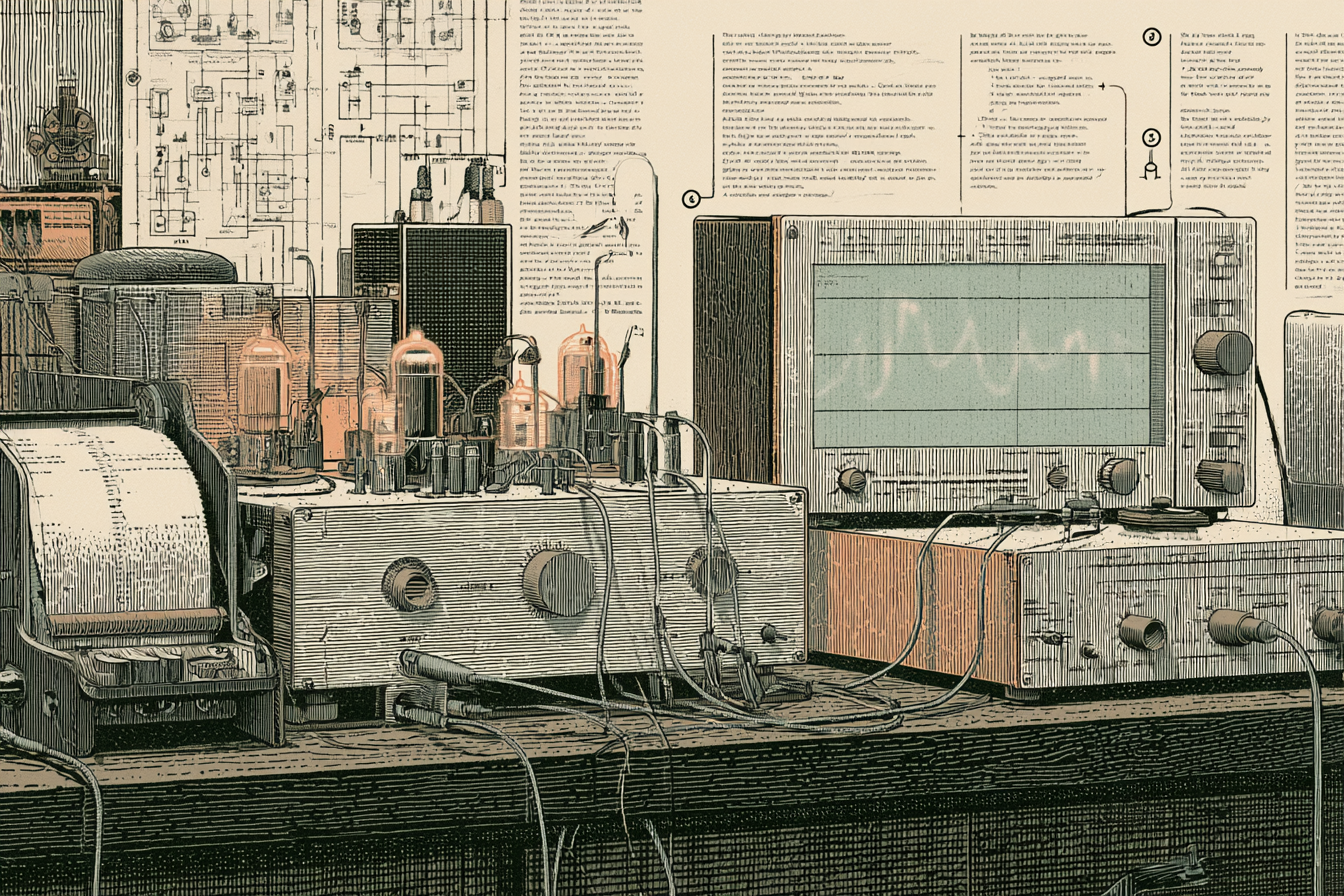
The later apparatus will appear more exact because it converts variation into traces: lines, pulses, numbers, and recorded intervals. Yet its authority will still depend on rooms, rules, trained hands, and accepted thresholds of error. The lantern changes its fuel; the work of looking does not disappear.
Working Terms
- Instrument
- A material or imagined arrangement that stabilises attention long enough for an observation to be repeated, compared, or revised.
- Trace
- A mark, image, utterance, or measurement retained after an event, together with the conditions that make it interpretable.
- Restraint
- A practice that delays conclusion so that an experience can acquire a comparable form.
A Practical Interval
The first instrument in this archive is not an antique object. It is an interval: the time between receiving an impression and naming its cause. A reader can make that interval practical without adopting any old cosmology. The following sequence is deliberately small. It offers no revelation, only a way to leave a better record of uncertainty.
- Describe the occasion before assigning it a category.
- Name one material condition that might have shaped it: light, fatigue, weather, company, noise, or expectation.
- Return to the account later and mark what now seems secure, what remains ambiguous, and what was added by memory.
That final return is an act of generosity toward the earlier self. It admits that the first account was made under conditions that can no longer be recovered. It also admits that later confidence has its own conditions. A record becomes trustworthy not because it escapes revision, but because it leaves room for revision to occur.
Sources Cited in This Chapter
- The Latin tradition of memoria joined recollection to training, rhetoric, and moral formation. It cannot be reduced to a neutral storage model without losing the institutional settings in which it was practiced. ↩